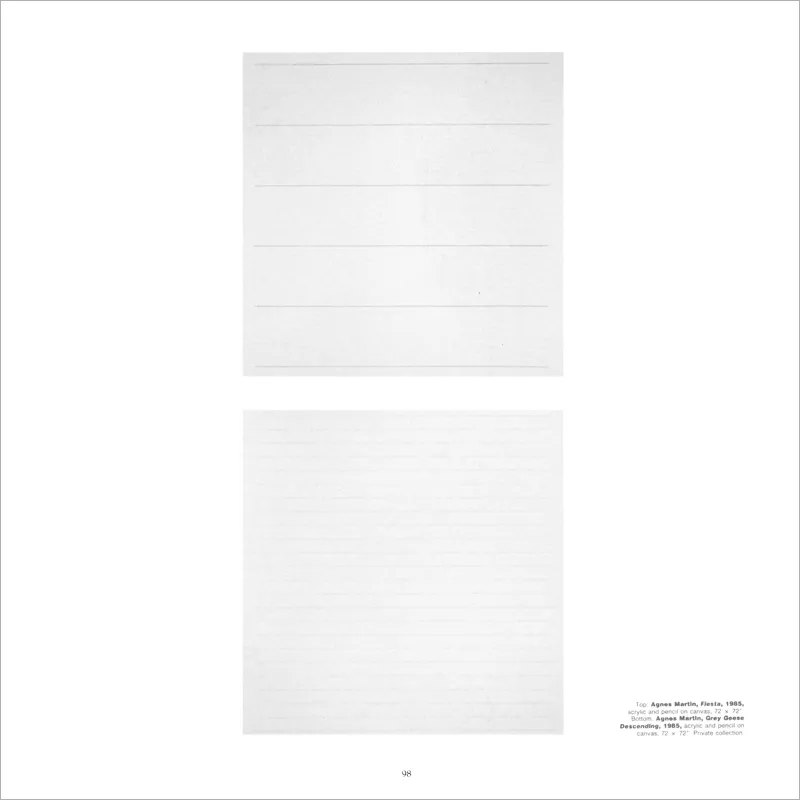
‘Grey Geese Descending’ by Agnes Martin
In a 1989 interview for the Archives of American Art, the interviewer Suzan Campbell raised the issue with artist Agnes Martin of a man who complained about the lack of geese in her abstract painting Grey Geese Descending:
SUZAN CAMPBELL: And you said, it wasn’t about the grey goose descending so much as my feeling while watching the grey goose descending.
AGNES MARTIN: Yeah. We have certain feelings when birds descend. And that’s what the painting is about. Yes.[1]
Agnes Martin is not the only abstract artist to have advanced this idea that what their art depicts is not the thing itself so much as the feeling or experience of the thing. Famous abstract artist Martin Rothko stated:
I’m interested only in expressing basic human emotions—tragedy, ecstasy, doom and so on, and the fact that lots of people break down and cry when confronted with my pictures shows that I communicate those basic human emotions. . . And if you, as you say, are moved only by their color relationships, then you miss the point.[2]
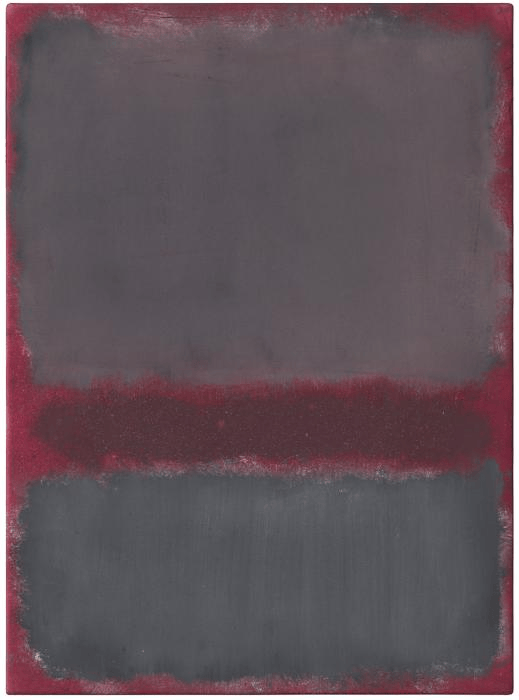
‘Untitled’ (1967) by Mark Rothko
Abstract art can be divisive. Studies have shown that random members of the public are more likely to have similar tastes and associations for representational art—that is art representing real world subjects or objects—than abstract art.[3] This is also true for representational photographs, rather than abstract photographs.[4] This phenomenon develops from an early age.[5] Studies have shown that, on average, people show more physical signs of emotional response to representational art, are quicker to associate positive words to representational art, and are quicker to emotionally relate to representational art.[6] Yet studies have also shown that artists relate to abstract art more easily than the general public, that experts do not discriminate based on abstraction level, and that a small amount of training in art theory can increase appreciation of, but reduce excitement for, abstract art.[7]
21st Century Media
In our fragmented attention economy, short-form content is king. Consumers want shorter news articles and young people are addicted to short-form content, spending as much time watching Tiktok each day as they spend playing video games and far more than they spend watching Youtube.[8] Short-form videos are even important in shaping what long-form content young people watch.[9]
Short-form video content—reels, shorts, and Tiktoks—are the trendy medium and they’re a relatively rich medium. They may not be long enough for complex narratives but they can utilise sound and movement for aesthetic effects impossible in painting and they can still pack in short, simple stories too.
Painting can be powerful but it has its limitations. Flattened on the canvas, there’s no feeling of depth and little sense of scale. Few paintings tower over you like a statue in a public square. Frozen in time, its story-telling power is limited. Few would become enthralled in the plot of a painting as they would the plot of a movie. Silent, a painting struggles to make you want to dance to the rhythm like almost any song can.
Painting is a relatively low-dimensional medium. It uses two dimensions of space, none of time, and engages only one sense. Video is relatively high-dimensional, using two dimensions of space, one of time, and engaging at least two senses. The information which can be conveyed by a short video is exponentially more than what can be portrayed by a painting.
In some ways, more is more. Video now dominates our media landscape and static and flat mediums like books and painting struggle to be profitable.
In other ways, less is more. Tiktoks and Instagram reels have become home to an array of genres which are relatively simple in concept.
If you search ‘ASMR’, you’ll be greeted by a range of videos presenting simple sets of sound, colours, and textures which, at times, feel spiritually similar to abstract art.
To be clear, these are not art. That is not meant derisively. Most ASMR exists to entertain and to relax and does not usually stray outside those boundaries. Art may seek to make you feel relaxed or stressed or disturbed or any number of emotions in between. It can entertain or teach or philosophise or challenge and the ambiguity and flexibility is what makes it different than the narrow confines of genre. Yet modern Tiktok and Instagram are host to all sorts of micro-genres and niches which break the bounds of conventional genres in terms of content, instead finding commonality in more abstract elements, such as tone and aesthetic. Compared to what came in previous decades and centuries, they are bizarre and subversive, yet they are pedestrian fare for these apps.
Even “AI slop” can feel like abstract art.
Given the strangeness of this ‘normal’ content, it should be no surprise then that there are also abstract artists who have made their home on these apps and are exploiting the richness of this new medium and open-mindedness of modern audiences to good effect.
What is reel art?
For the last 7 years, @cosmodernism has been messing with materials, microscopes, and music to create evocative short videos. Despite being a digital artist, the project’s creator Kamil Czapiga puts a big emphasis on manipulating physical, exotic substances and materials to create unique textures. The continuing variety of forms and textures on display is impressive when the project posts multiple times a week. Some reels are affecting and some are revolting—squishy, slimy, and uncomfortably biological—but all are inventive.
Less slimy and revolting, the meditative videos of @romandegiuli play spacey music over hypnotic visuals. If Cosmodernism’s videos feel more like a scientist in the lab, Roman de Giuli’s videos hold a sense of wonder at nature and the universe, many of them feeling cosmic even if shot on planet earth. There’s something tender about his love of laidback music and swirling textures.
Not all abstract art on Tiktok and Instragram is people swirling paint around. Other artists lean into the more bizarre absurd.
Clickbait videos are common on Tiktok and Instagram but a thirst for attention fails to explain the meticulous craft poured into the bizarre reels of @friendlyjapaneselesson. Framed as a language learning channel and riffing on common short-form genre conventions, these reels are an unnerving combination of high-quality voice-acting played-straight paired with incongruous face-painting, puppetry, and miniatures. Nothing quite fits and its a winding path through the uncanny valley.
@almightyopp is another account cognizant that puppetry is uncanny and which leans into it for dramatic effect. Nominally focusing on themes of mental health, the emphasis seems to be on evoking feeling than incisive commentary.
The future of art
Not all modern art remains flattened on the page or frozen in marble.
As you enter into the first gallery of Signal Space, a digital art gallery in Prague, the lights dim. Pushing your way through two fire doors, you feel a reverberent hum in your chest. An array of glowing beams is rotating on a wall. As you creep through the dark to a bench, you notice how the intensity and tones of the synth music shift with the pink and blue lights and the spinning of the bars. Patterns creep along the wall in unpredictable ways and the music swells and falls like a sci-fi soundtrack. You notice patterns in the movement and, after a few minutes, you feel like you have grasped the full extent of the piece. Suddenly, the pattern shifts: bars start strobing, the music crackles, everything moves chaotically. A new phase has started.
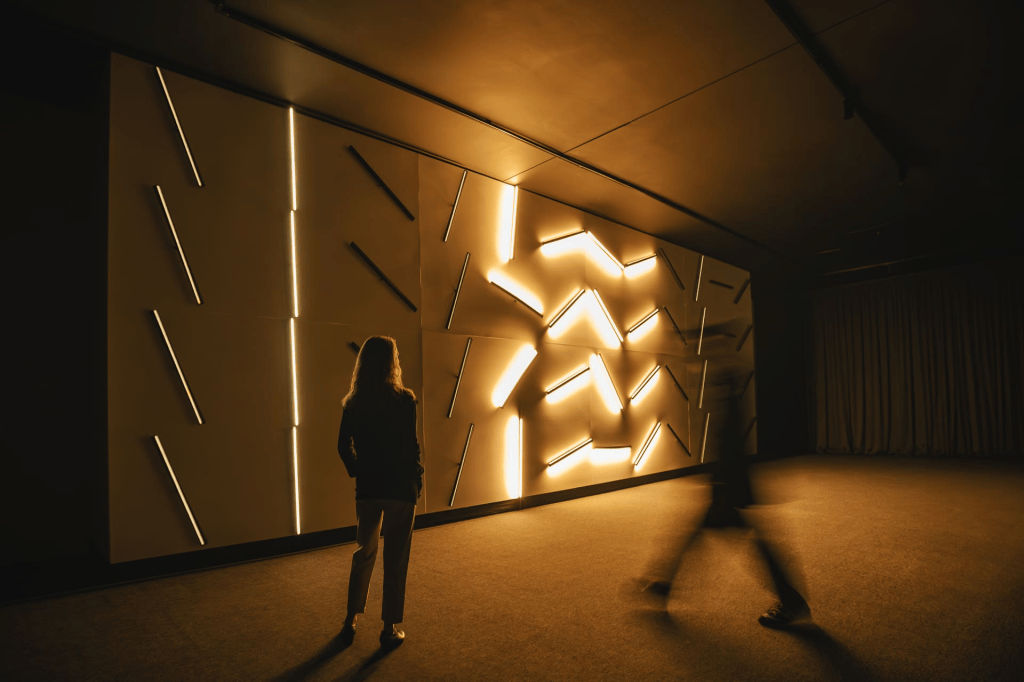
Signes is a generative artwork. Algorithmically driven, it always alters and semi-randomly changes. Sometimes it’s like calm ASMR and others times it’s like a warehouse rave. It’s quality to reinvent itself keeps it endlessly novel and tempts you to keep watching to see what happens next… What if you miss something good?
Across the six rooms of Signal Space, the installations use sound, video, lasers, sculpture, movement, randomness, and even interactive elements to explore forms and ideas. The full experience engages most of your senses and can be experienced for as long or as short of an amount of time as you wish.
It can leave a deep impression to enter into a space and see things in the flesh which you’ve never seen before. The scale of the sound and sights demands attention, just as the cinema or big screen TVs are more engaging than a tiny TV.
‘Fighters’ by Quayola and Max Cooper.
It’s not to say that Signal Space has completed art and found a perfect form–all mediums have strengths and limitations–but the visceral appeal demands attention and can be appreciated on many levels. Even children are drawn in by the strange sights and sounds, even if they’re unable to appreciate cultural or political commentary. In a recent visit, we sat and watched children playing, chasing after shapes, as the whole room appeared to shift and sway with the projection of a 360° film projected across every surface.
[1] American Art, ‘Oral history interview with Agnes Martin’ (15 May 1989) [https://www.aaa.si.edu/collections/interviews/oral-history-interview-agnes-martin-13296] accessed 22 October 2026
[2] The Museum of Modern Art, Karen Kedmey, ‘Mark Rothko’ (2017) [https://www.moma.org/artists/5047-mark-rothko] accessed 22 October 2026
[3] Astrid Schepman and others, ‘Shared liking and association valence for representational art but not abstract art’ (Journal of Vision, 2015)
[4] Edward Vessel and others, ‘Beauty and the beholder: Highly individual taste for abstract, but not real-world images’ (Journal of Vision, 2010)
[5] Paul Rodwar and others, ‘The Development of Shared Liking of Representational but not Abstract Art in Primary School Children and Their Justifications for Liking’ (Frontiers in Human Neuroscience, 2016)
[6] Giulia Cabbai and others, ‘Emotion, Embodiment, and Aesthetic Appraisal: The Impact of Interoceptive Abilities and Art Type’ (Psychology of Aesthetics, Creativity, and the Arts, 2024)
Stefano Mastandrea and others, ‘The automatic aesthetic evaluation of different art and architectural styles’ (Psychology of Aesthetics, Creativity, and the Arts, 2011)
Gerger Gernot and others, ‘Empathy, Einfühlung, and aesthetic experience: the effect of emotion contagion on appreciation of representational and abstract art using fEMG and SCR’ (Cognitive Process, 2018)
[7] Jane Else and others, ‘Art expertise modulates the emotional response to modern art, especially abstract: an ERP investigation’ (Frontiers in Human Neuroscience, 2015)
Elina Pihko and others, ‘Experiencing Art: The Influence of Expertise and Painting Abstraction Level’ (Frontiers in Human Neuroscience, 2011)
Jorien van Paasschen, ‘The Influence of Art Expertise and Training on Emotion and Preference Ratings for Representational and Abstract Artworks’ (PLoS ONE, 2015)
[8] Quostodio, ‘Lost in the Scroll: Qustodio Releases New Data on How Algorithms, Apps, and AI Are Shaping Childhood’ (10 February 2026) [https://www.qustodio.com/en/research/annual-report-2025/] accessed 22 October 2026
[9] Kineree Shah, YouGov, ‘How short-form video on social media is impacting TV viewership in 2026’ (12 March 2026) [https://yougov.com/en-gb/articles/54298-how-short-form-video-on-social-media-is-impacting-tv-viewership-in-2026] accessed 22 October 2026

Written by Nathan Price

